Application · Surface heating

Fixing systems for
Wall Heating
Radiant heat from the wall.

Wall heating is the underestimated alternative to underfloor heating – the same technology, a different surface, different strengths. As a surface heating system, it operates at low flow temperatures and emits heat evenly across the entire wall surface. The result: a pleasant indoor climate without visible heating equipment and without dry heated air.

Wall heating with vertically laid heating pipes on a fixing rail
Technical knowledge

Operating principle · Installation

01
Operating principle

How does wall heating work?

As with underfloor heating, in hydronic wall heating heating water circulates through a pipe system – in this case within or behind the wall. Flow temperatures are typically between 30 and 45 °C.

Heat is emitted primarily through radiation, not convection. This means that the room air is heated less, while people perceive the heat directly – similar to the warmth of the sun.

Electric versions using heating film or heating mats are also available, particularly for smaller areas or retrofit solutions.
02
Installation

Installation and fixing.

Depending on the wall construction, the heating pipes are installed directly in the plaster, in a substructure or on a backing panel. Common pipe spacings range between 10 and 20 cm – depending on the desired heating output and the available wall area.

Fixing is provided by U-Rails or special wall fixing systems that ensure uniform pipe routing and permanently stable fixing.

Important for planning: wall areas that will later be covered by furniture should be taken into account in the design.

Advantages

Why wall heating?

01

Pleasant radiant heat

Acts directly on people – similar to the warmth of the sun, not via the air.

02

Low flow temperatures

30–45 °C – ideal for heat pumps, condensing technology and solar thermal systems.

03

Independent of floor covering

Particularly relevant in existing buildings with valuable floors.

04

Fast response time

Walls have less thermal mass – faster response to setpoint changes.

05

Low-profile system construction

No loss of height due to screed – ideal for refurbishment.

06

Reversible for cooling

Can be used for surface cooling in summer – a sought-after feature in modern concepts.

Particularly efficient: wall heating can easily be combined with Underfloor Heating – for optimal heat distribution throughout the room.

Applications

Refurbishment, heritage conservation, cooling.

Wall heating is particularly suitable where underfloor heating is not possible or practical: when refurbishing older buildings without replacing the screed, in rooms with difficult substrates or in buildings with particularly high ceilings where underfloor heat alone is insufficient.

In heritage conservation , wall heating is also a frequently chosen solution – it can be integrated behind historic surfaces without affecting their appearance. In addition, wall heating can be used reversibly in summer for surface cooling – an increasingly sought-after feature in modern building concepts.

Design & standards

DIN EN 1264 & VDI 2078.

Wall heating is also designed in accordance with DIN EN 1264, supplemented by the requirements of VDI 2078 for cooling operation.

Particular attention must be paid to the dew point: during cooling operation, condensation on the wall surface must be reliably prevented through controlled flow temperature and room-air monitoring. Hydraulic balancing is mandatory – as with all surface heating systems.

Walls & ceilings

Pipe fixing on walls and ceilings.

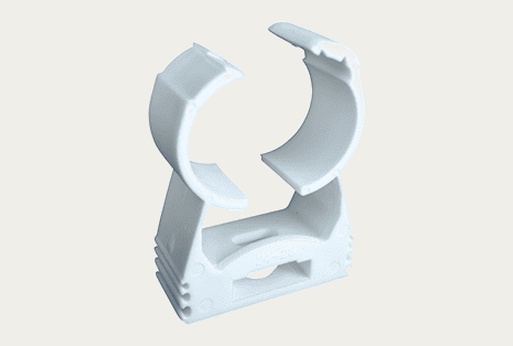
For wall heating, ceiling heating and ceiling cooling, the heating pipes must be permanently and accurately fixed to vertical surfaces or overhead. In addition to U-Rails, the SW clamp is suitable for this purpose: a pipe clamp for heating pipes with outside diameters from 14 to 35.8 mm, available in five sizes, easily mounted on walls or ceilings and temperature-resistant from −30 °C to +85 °C.

SW clamp pipe clamp for walls and ceilings
Pipe clamp
SW clamp
Fastening technology

Fixing for walls.

In wall heating, the fixing structure must perform the role that screed fulfils in underfloor heating: permanently stable, correctly positioned fixing of the heating pipes. High-quality U-Rails and fixing systems suitable for vertical use are not optional here, but a prerequisite for installation in accordance with the relevant standards.

  • Correctly positioned fixing despite gravity
  • Uniform pipe routing across the entire wall surface
  • Stability for plastering and cladding work
  • Installation in accordance with DIN EN 1264