
Application · Outdoor surfaces

Fixing systems for
Snow-Melting Systems
Safe surfaces in ice and snow.

Snow-melting systems ensure safe surfaces in ice and snow and automatically perform the tasks that would otherwise require gritting services, snow shovels and de-icing salt – around the clock, reliably and without manual effort. Whether a driveway, ramp, staircase or footpath: heating installed below ground keeps the surface permanently free of snow and ice, thereby minimising slip hazards, liability risks and winter maintenance costs.

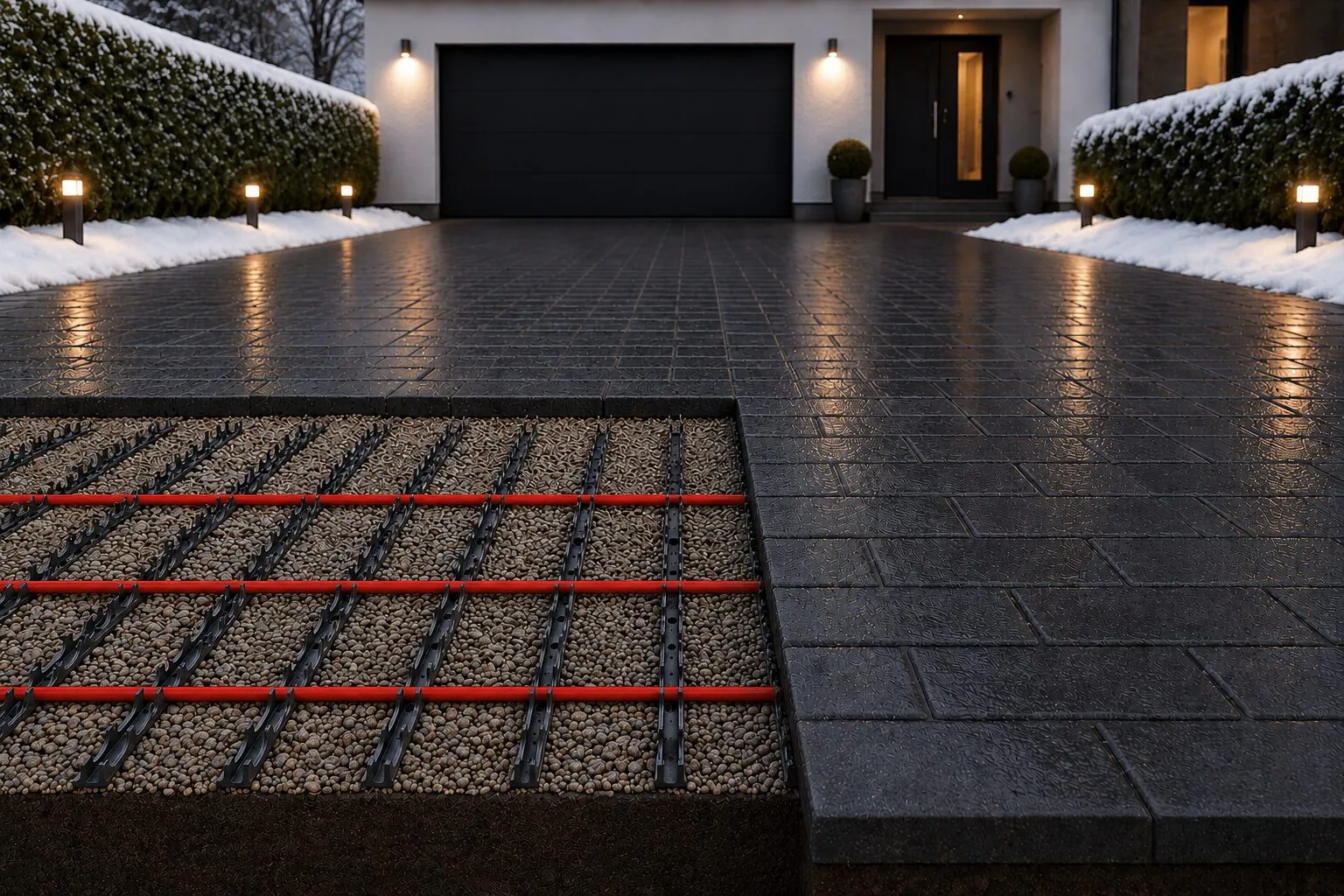
Heated paved driveway – snow-free despite snow-covered surroundings
Technical knowledge

Operating principle · Installation · Control

01
Operating principle

How does a snow-melting system work?

The principle is the same as that of Underfloor Heating – adapted to outdoor requirements. A pipe system is laid beneath the surface paving and warm water flows through it.

Unlike Grass Heating , snow-melting systems must provide significantly more energy: the surface must not only be kept frost-free, but actively heated – typical flow temperatures range between 35 and 55 °C, with heating output between 250 and 400 W/m² depending on the location and usage requirements.

Electric systems – using heating cables or heating mats – are more economically competitive here than in Grass Heating, as the heated areas are often smaller. For larger areas from approximately 50–100 m² upwards, the hydronic version is generally superior in terms of energy efficiency and economics.

02
Installation

Installation and construction.

The heating pipes or heating cables are laid directly in the substrate – for block-paved or slab-paved areas, typically in the mortar bed or in a levelling layer; for concrete roadways, in the concrete itself. Pipe spacing usually ranges between 10 and 20 cm, depending on the required heating output.

Uniform installation across the entire area is important: gaps in the heating system lead to patches of ice on the surface – precisely where the slip hazard is greatest.

Compression-resistant, weather-resistant fixing systems are required to secure the heating pipes in the substrate. U-Rails or fixing Clips must permanently withstand the mechanical stresses caused by traffic, freeze-thaw cycles and settlement. Correctly positioned fixing before the surface layer is installed is crucial – subsequent adjustment is not possible once installed.

03
Control

Sensors instead of continuous operation.

A well-designed snow-melting system does not run continuously – that would be unjustifiable in terms of energy use and cost. Modern systems are controlled by combined sensors that measure surface temperature and moisture simultaneously. The heating activates automatically when there is a risk of frost and moisture is present or beginning to form.

In addition, a weather station and forecast data can be incorporated to control the system proactively. Smart control systems also allow integration into building automation and energy management systems – particularly relevant for commercial properties with complex utility supply structures.

Advantages

Why a snow-melting system?

01

Automatic winter maintenance

No manual clearing, no de-icing salt – the system works around the clock.

02

Maximum traffic and pedestrian safety

No slip hazard on paths, ramps and steps – even at night and at weekends.

03

Minimised liability

Particularly relevant for businesses, the public sector and the housing industry.

04

Surface protection

No freeze-thaw damage caused by de-icing salt or mechanical clearing equipment.

05

Convenience & fully automatic operation

Sensor-controlled operation – without staffing requirements or routine checks.

06

Durability

Low-maintenance system with a long service life when correctly designed.

Applications

Traffic and pedestrian safety as an obligation.

Snow-melting systems make sense wherever traffic and pedestrian safety and accessibility in winter are not optional, but mandatory. In public settings – such as hospitals, care facilities or railway stations – automatic snow and ice removal is often operationally necessary. Snow-melting systems are also increasingly in demand in high-end private settings, for example for prestigious driveways or terraces.

  • 01Driveways and underground car park ramps
  • 02Entrance areas and steps
  • 03Footpaths and pedestrian zones
  • 04Loading ramps and service yards
  • 05Bridges and parking decks
  • 06Hospitals, care facilities, railway stations
Design & standards

DIN EN 1264 & DIN VDE 0100-705.

The design depends on the site's climatic conditions, the use of the area and the available energy sources. Design guidance is provided by DIN EN 1264 for hydronic systems, as well as manufacturers' specifications for pipe spacing, heating output and pressure loss. For electric systems, the applicable standard is DIN VDE 0100-705.

Installation in accordance with the relevant standards – including pressure testing before the surface layer is installed – is mandatory for all versions.

Fastening technology

Compression-resistant, frost-proof, durable.

In a snow-melting system, fixing technology is a safety component: it keeps the heating pipes precisely in position during installation – and throughout their service life under traffic loads, freeze-thaw cycles and settlement. Subsequent adjustment after backfilling is not possible.

  • Compression-resistant materials for traffic areas
  • Resistant to freeze-thaw cycles and UV
  • Positionally stable fixing in mortar beds or concrete
  • Uniform pipe routing across the entire area – no patches of ice