
Application · Sports & outdoors

Fixing systems for
Grass Heating & Sports Surface Heating
Optimal pitch conditions.

Grass Heating ensures optimal pitch conditions – even in frost and sub-zero temperatures, sports turf remains reliably playable, with uniform, energy-efficient heating. Whether a professional stadium, training ground or municipal sports facility – sports venues of all sizes benefit: well-designed Grass Heating protects turf from frost damage, extends the growing season and ensures play can continue even during the cold season.

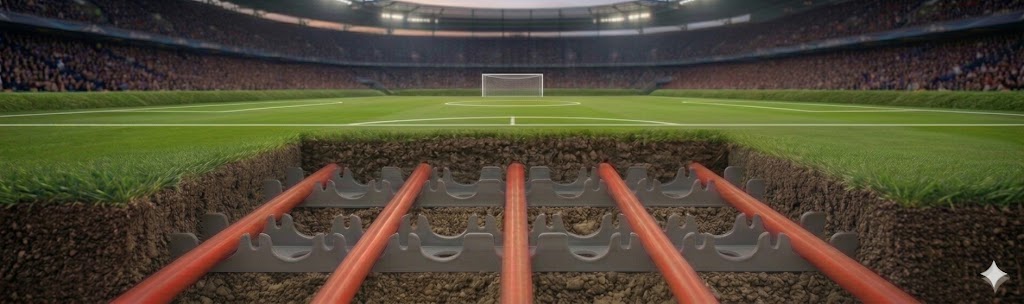
Stadium turf with heating pipe in the ground construction – Grass Heating for sports pitches playable all year round
Technical knowledge

Operating principle · Installation · Control

01
Operating principle

How does Grass Heating work?

The operating principle is the same as that of Underfloor Heating – adapted for outdoor use. A pipe system is laid beneath the turf and warm water flows through it.

The flow temperatures are deliberately kept low: the aim is not to heat up the grass, but to keep the soil just above freezing point – typically at a soil temperature of 4 to 8 °C. This is sufficient to prevent frost in the root zone and keep the grasses active.

Electric systems are rarely economical in this application due to the large areas and correspondingly high energy demand, and are therefore seldom used.

02
Installation

Installation and system construction.

The heating pipes are generally installed at a depth of 8 to 15 cm beneath the turf surface – deep enough not to affect play, shallow enough to control the soil temperature efficiently. Depending on the design, pipe spacing ranges between 15 and 30 cm.

Uniform installation over the entire area is crucial to avoid temperature differences in the turf – so-called cold and warm zones would adversely affect turf quality and playing characteristics.

Fixing systems specifically suitable for outdoor use are used to secure the pipes below ground. These must remain resistant to UV, frost and soil pressure over the long term. U-Rails made of suitable plastic or stainless steel keep the pipes correctly positioned during backfilling and throughout operation.

03
Control

Smart control saves energy.

Modern Grass Heating systems are controlled using soil sensors and a weather station . The system only runs when there is a risk of frost – significantly minimising energy consumption.

Smart control systems can incorporate weather forecasts and activate the heating proactively before frost sets in. In combination with heat pumps or the use of waste heat from other building processes, Grass Heating can be operated particularly economically.

Advantages

Why Grass Heating?

01

Year-round playability

Play continues even in frost and adverse weather – no cancellations due to cold pitches.

02

Protection of the turf

No frost damage in the root zone – the grasses remain active.

03

Extended growing season

Better turf recovery even during transitional seasons – higher turf quality.

04

Energy-efficient

Low target temperatures and demand-based control minimise consumption.

05

Planning reliability

Reliable pitch conditions for play and events.

06

Investment protection

Permanently protects high-quality turf areas and the associated infrastructure.

Applications

From professional stadiums to landscaped gardens.

Grass Heating makes sense wherever turf areas must be used regularly and reliably – regardless of the weather. The classic applications are football stadiums and professional sports facilities, where cancelled matches or poor pitch conditions have significant economic consequences.

However, Grass Heating is increasingly being installed on training grounds, municipal sports facilities, golf courses and prestigious outdoor grounds. The system is also occasionally used in private settings – for example in extensive gardens with high-quality lawn landscaping.

Design & standards

FIFA, DIN 18035 & hydraulics.

The design is based on the site's climate data, the desired soil temperature and the available energy source. Relevant design guidance is provided by the FIFA regulations for professional turf, the DIN 18035 standard for sports grounds and manufacturers' specifications for pipe materials and installation systems.

Careful hydraulic design with pressure loss calculations and balancing of the heating circuits is also essential here.

References

In use in professional stadiums and on golf courses.

U-Rails from Winkler Technik lie beneath the turf of numerous professional stadiums – in Bavaria, North Rhine-Westphalia and many other regions. Our systems also ensure reliable Grass Heating operation in several American football stadiums in the USA and on golf courses. The requirements are demanding: pipe fixing must be precisely positioned when installed on soil and hold for decades – beneath turf, the drainage layer and daily loads.

Fastening technology

Robust below ground.

The fixing technology within the ground construction must deliver lasting performance – even under soil pressure, frost and UV exposure. High-quality U-Rails and fixing systems secure the pipe position during backfilling and throughout the system's service life.

  • Materials resistant to UV, frost and soil pressure
  • Positionally stable fixing during installation and operation
  • Uniform pipe spacing – no cold or warm zones
  • Suitable for stadiums, sports grounds and outdoor facilities
FAQ

Frequently asked questions about Grass Heating

01

Which fixing is suitable for Grass Heating?

A proven solution is U-Rails on soil, secured with suitable Rail Fixing such as retaining pins or T-anchors. They maintain exact pipe spacing and can be installed quickly over large areas.

02

Which sports surfaces does Winkler Technik supply?

For football and American football stadiums, training grounds, golf courses and municipal sports grounds – from individual projects to large areas.

03

Does Winkler Technik also supply international stadium projects?

Yes. Our systems are used in stadiums in Europe and the USA; we supply system providers and wholesalers in over 35 countries.